Rolf
The Disappearance of Josef MengeleRolf is the son of Josef Mengele, but his childhood begins under a false account of his father’s absence: he is told that Josef died in combat in Russia shortly after Rolf was born. When father and son meet at Engelberg, Josef is living under an assumed identity and Rolf knows him as Uncle Fritz. The encounter offers a brief picture of family closeness, but its warmth rests on concealment. Rolf later learns that his father did not die in Russia; he was the Auschwitz Angel of Death. That discovery changes the meaning of the earlier idyll and shadows Rolf’s later distance from his father’s family.
Childhood and the False Story of His Father
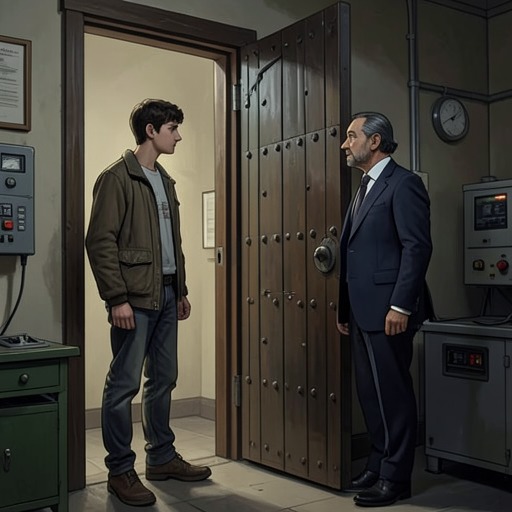
Rolf arrives at the Hotel Engel with Martha, his mother, and Karl-Heinz, Martha’s son. Sedlmeier has brought Josef to the resort, where the two boys greet him alongside Martha. For Rolf, however, the visitor is not his returned father. Martha has introduced Josef as Uncle Fritz from America, while Rolf has grown up believing that Josef died in the war. The narrative places the concealed identity inside an ordinary family arrangement: a mother, two boys, and a trusted adult sharing a holiday without Rolf knowing what binds them.
That difference in knowledge defines the scene. Josef can observe his son, but Rolf encounters a man whose history has been withheld from him. The disguise is not merely a name: it lets Josef enter the boys’ daily life as a raconteur and admired guest. Their apparent intimacy therefore coexists with an unspoken division between what Rolf has been told and what his father knows. The story of the father’s death in Russia makes the later revelation more than a correction of detail; it overturns the account that has organized Rolf’s understanding of his family.
Uncle Fritz at Engelberg
The boys are described as punctual and disciplined. At table they sit upright and speak only when Josef authorizes them to do so. They look up to Uncle Fritz, who presents himself as a world-class skier and recounts service with the Alpine troops. During dinner, walks, and evenings together, they urge him to tell stories. Karl-Heinz is drawn to accounts of tank battles, heroism, and comradeship on the Russian steppes; Rolf’s attention goes instead to stories of San Martín, gauchos, and the South American pampas.
Josef’s storytelling does not remain innocent adventure. He links the conquest of the Argentine desert to the German wartime conquest of eastern territories, casting both as victories of civilization over supposed barbarism. He also tells the boys that Germans surpassed the Greeks in talent and the Romans in strength. The scene shows how the false uncle’s authority operates: the boys’ admiration gives his political lessons the form of family entertainment. Rolf is present as a listener, but the evidence does not show what he makes of these claims. What it does establish is that the man he trusts as Uncle Fritz uses their evenings together to pass on a racialized and nationalist account of history.
A Son Under His Father’s Gaze
Josef studies Rolf whenever he has the opportunity, noticing in him his mother’s hands and nose, melancholic eyes, fragile beauty, and artlessness. These details are presented through the father’s observation rather than through Rolf’s own account of himself. Josef measures the boy against Karl-Heinz, who is taller by a head, skis better, and seems closer to manhood. Rolf, by comparison, remains a child; he has not settled on what he wants to become and moves from one possible future to another, considering work as a fireman, astronaut, or engineer.
The contrast also prompts Josef to remember his own youth. At ten, he was absorbed by a microscope his father gave him; by fifteen, he had decided not to remain in Günzburg under his father’s influence. He recalls his certainty that doctors and researchers would become the twentieth century’s celebrated figures, and his fascination with scientific discovery and the medical experiments that made headlines. These recollections frame Rolf’s uncertainty against Josef’s remembered ambition. They also expose the limits of the father’s attention: he can scrutinize his son’s appearance and compare their temperaments, but Rolf’s changing hopes remain unresolved in the account.
Revelation, Distance, and Departure
By the time the narrative reports on Rolf’s later life, he knows that his father did not disappear in Russia but was the Auschwitz Angel of Death. Josef tries to justify and minimize his role to people in Asunción, but others avoid him. Rolf’s knowledge belongs to a different register: the childhood cover story has given way to the identity associated with Josef’s crimes. The account does not describe the moment Rolf learns the truth or record his words about it; it establishes the revelation and its place in the changed relationship between father and son.
Sedlmeier later tells Josef that Rolf is doing well in Freiburg and studying law. He also reports that Rolf snubs his cousins and the rest of the family, attributing this distance to his mother’s influence. This is Sedlmeier’s account, not Rolf’s own explanation, and the narrative supplies no further detail about his studies or his relations with his mother. Still, the contrast with the disciplined boy at Hotel Engel is striking: the child once gathered with Karl-Heinz to hear Josef’s stories is now separate from the family circle that continues to support his father.
In September 1960, as Mossad closes in on Krug’s farm, Josef decides to disappear again. He must part from Martha and Karl-Heinz, who return to Europe without saying goodbye to him. Rolf is not named among those departing in this account, so the scene does not establish his precise role in that separation. Its consequence for his story is nevertheless clear in the larger pattern: the father who once watched him at a Swiss resort cannot sustain a family life in the face of exposure and pursuit. Rolf’s trajectory is shaped by concealment first and distance afterward. He is introduced through a lie about his father, then located among the relatives from whom he has withdrawn, while Josef’s flight carries him farther from the son he had once observed so intently.